Full Case Study
Method for Teaching Cognitively Impaired or Developmentally Disabled to Read
Abstract
A man with intellectual and developmental disabilities was unable to independently learn new words by using existing methods (e.g. phonics, rote). The relevant disability is not currently described in any literature that I could find. A new method of learning words was discovered and implemented, resulting in the man's ability to learn new words independently.
Relevant Impairments
The impairments of the man in this case that most affected his ability to read were short-term memory, attention and executive functioning. Short term memory was measured at three to four elements. Traditional methods require one to hold in memory each letter-sound, an impaired short-term memory, therefore, makes learning a new word with more than three letters impossible. Attention was consistently noted as an impediment to progress, causing a significant amount of ‘starting-over’ during a task. Executive functioning impairments presented themselves as an inability to ‘screen-out’ thoughts that arose during a task. This is not to be confused with the lack of attentive ability, which often occurred as a separate issue.
The man in this case often knew that an answer was incorrect, but would say it anyhow and correct himself after the fact. If his attention was not focused, he would not notice these errors, and would often forget what he had said due to the low level of short-term memory.
The Fundamentals of Reading
Reading is a task that, at its fundamental elements, consists of two processes: recognizing the letter-sound, and integrating the sounds to form a word. Traditional methods do not consider steps that the brain takes naturally, steps which those who suffer cognitive impairments may not be able to perform without significant rehabilitation. In this case, the missing fundamental element was the ability to connect two, discrete, sounds together to form one, continuous, sound. This process can be attempted by the reader by trying the following:
- Pronounce the following two sounds: “Oh” and “Bee”.
- Now, connect the two sounds into one sound. You should be making the sound “Obie”, as in Obi-Wan Kenobi.
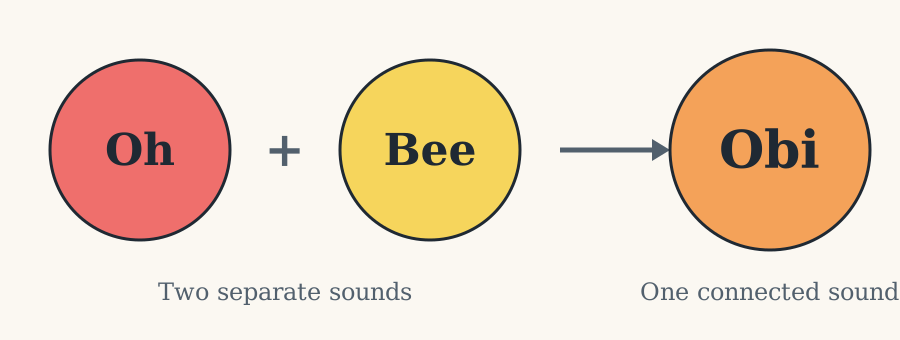
The man in this case is a big Star Wars fan, so the first example uses a name he already loves. Starting from something he cared about helped make the practice feel like play.
This process was practically impossible for the man in this case to perform. Such a deficiency, once uncovered, brings to light the previously mysterious lack of ability to learn reading with traditional methods. Once this was discovered, it was practiced with many combinations for several weeks. Improvement in this ability was rapid, taking only a few months to become proficient.
Discovering a New Method
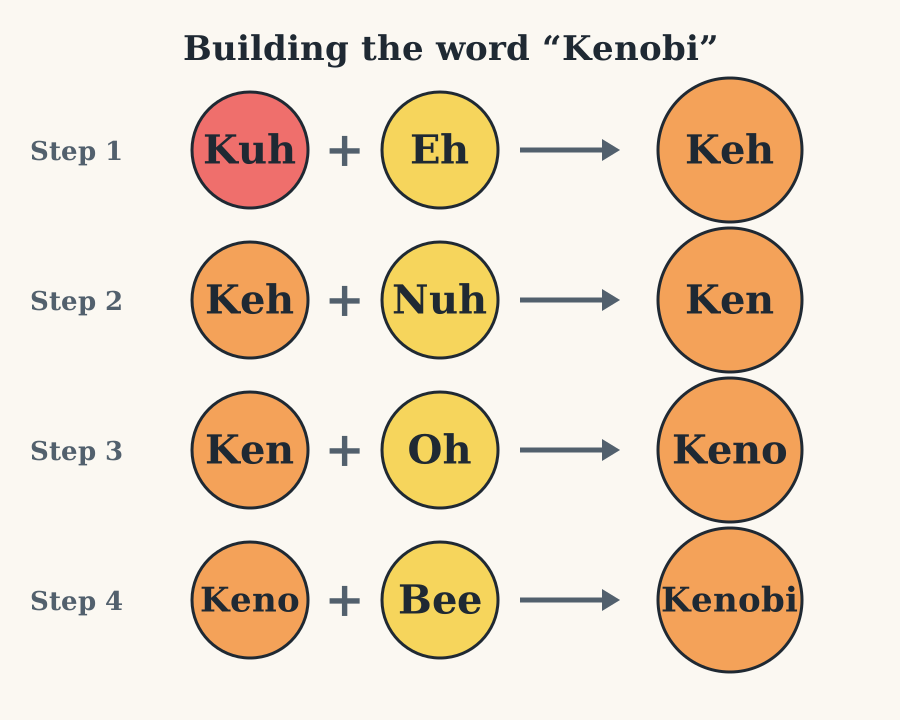
Once the ability to connect two distinct sounds into one continuous sound was rehabilitated, there was still the problem of short-term memory to overcome. As a constraint that could not be overcome with any learning method, it would have to be worked around. To accomplish this, only two elements could be connected at the same time so as not to stress the available memory. This makes learning a new word a very tedious process, but at this point no alternative presented itself. The method is taught as two steps: say two sounds and connect them. Repeating these steps resulted in pronouncing the whole word; a method that reduces traditional phonics to a level that addressed the disability of the man in this case had been discovered.
The Method
- Say the first two letter sounds in the word.
- Connect the sounds.
- Hold on to this ‘new’ sound.
- If there is another letter remaining, go on to the next step.
- Otherwise, the word is complete.
- Say the sound made in step two and the next letter sound.
- Go to step 2.
Timeline
I met the man in this case in the fall of 2011. It took until March of 2012 to discover the ability gaps and begin work on them. In less than one year, significant progress was made in these two abilities. First, the man gained the ability to connect two sounds together into one. Second, the man gained the ability to practice the method described above with minimal facilitation. As of the date of this writing, it is my belief that the man in this case is now able to begin learning to read with traditional methods, such as phonics.
It has been seven months since the first breakthrough in using the method was made. Over the course of our time together, the man and I have met once per week for two hours at a time. I do not consider it a strong assumption to believe that more frequent sessions would have resulted in a faster rehabilitation.
Implications
I believe this discovery is unprecedented in the academic literature. I was still attending UW Madison for economics and psychology while first discovering what I have described. Whether or not this is the case, the discovery and subsequent development of a teaching method can be used by those in the rehabilitation psychology and special education fields. I believe that, especially with younger cases, this methodology can improve the lives of those with certain developmental disabilities.
The case study is also available as a Word document on the Resources page.